Acrylamide/Bis Solution, 37.5:1(40 % w/v), 2.6 % C
Aqueous 37.5:1 solution of acrylamide and N,N'-methylene bisacrylamide (Bis)
for the preparation of PAGE gels for the separation of proteins >10 kDa and
analysis of DNA/protein interactions.
Not only are the ready-to-use gel
solutions easy to handle, there is no risk of neurotoxic acrylamide dusts in
the air. Ultra-pure acrylamide with very low acrylic acid content guarantees
the suitability of the gel solution for all electrophoresis applications
including high-resolution gel electrophoresis.
Each batch of gel solutions
is gel electrophoresis tested in our quality control laboratory. The use of
the solutions in the production of our ready-to-use gels guarantees highest
reproducibility and best separation results.
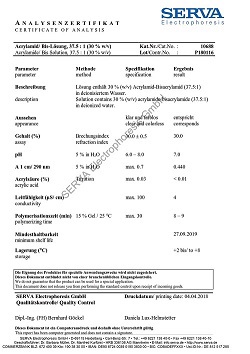
A 290 nm
pH
Conductivity (µS)
Content of free acrylic acid
|
< 0.7 (5 %)
6.0 - 8.0 (5 %)
< 100
< 0.03 %
|
| DANGER |
|
Substance of very high concern |
Carc. 1B, Muta. 1B, Repr. 2 •
GGVSE/ADR: 6.1 III UN3426 •
IATA: 6.1 III UN3426 •
WGK: 3 •
HS: 38229000
Storage Temperature: +2 °C to +8 °C
10681.02
4x 500
ml
inquire*
*Please use the inquiry form in the right column.
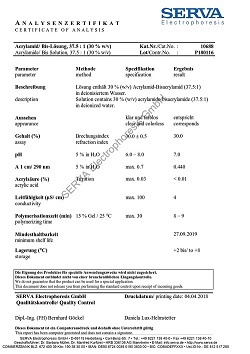
Certificates of Analysis
(Lot.-no. - release date)
Material Safety Datasheets
You may find this also interesting:
Electrophoresis by SERVA - Catalog
Certificates of Analysis
now online!
Close window
In detail you will find all products of NZYtech in 2025:
| • |
New Supreme NZY Reverse Transcriptase 1 kU/µL |
| • |
Quality products for the life science research |
| • |
Diverese portfolio for moleculare biology |
| • |
Everything for DNA & RNA purification, Real Time and End-Point PCR and much more |
| • |
Various enzymes for Glycobiology |
nzytech_catalogue_2025.pdf
Close window
Certificates of Analysis
now online!
How to find the required certificate of analysis for your product:
In the search, enter the 5-digit article number without additional packaging, i.e. 11404 if you are looking for the AZ for your 500 g-Pack Agarose 11404.02.
Now click on the search result and you will be taken to the product entry. Here you will find the link "Certificate of Analysis", which you follow.
Now select the lot number from the list and download the PDF with a click. Done.
SERVA InfoMail - Get the latest information
Close window
When subscribing to »SERVA InfoMail« you will receive information about the latest product release, special promotions, new jobs at SERVA and more. This service is, of course, free of charge.
You may remove your name any time from the list of recipients.
Quick Order
Close window
Using the Quick Order field, you can add a product to your shopping cart with just one click. All you have to do: enter the Cat.No. as shown in our catalog in the format xxxxx.yy and click the Go!-Button.
Close window
H302
Deutsch:
Gesundheitsschädlich bei Verschlucken.
English:
Harmful if swallowed.
Français:
Nocif en cas d'ingestion.
Italiano:
Nocivo se ingerito.
Español:
Nocivo en caso de ingestión.
Close window
H312
Deutsch:
Gesundheitsschädlich bei Hautkontakt.
English:
Harmful in contact with skin.
Français:
Nocif par contact cutané.
Italiano:
Nocivo per contatto con la pelle.
Español:
Nocivo en contacto con la piel.
Close window
H315
Deutsch:
Verursacht Hautreizungen.
English:
Causes skin irritation.
Français:
Provoque une irritation cutanée.
Italiano:
Provoca irritazione cutanea.
Español:
Provoca irritación cutánea.
Close window
H317
Deutsch:
Kann allergische Hautreaktionen verursachen.
English:
May cause an allergic skin reaction.
Français:
Peut provoquer une allergie cutanée.
Italiano:
Può provocare una reazione allergica cutanea.
Español:
Puede provocar una reacción alérgica en la piel.
Close window
H319
Deutsch:
Verursacht schwere Augenreizung.
English:
Causes serious eye irritation.
Français:
Provoque une sévère irritation des yeux.
Italiano:
Provoca grave irritazione oculare.
Español:
Provoca irritación ocular grave.
Close window
H340
Deutsch:
Kann genetische Defekte verursachen <Expositionsweg angeben, sofern schlüssig belegt ist, dass diese Gefahr bei keinem anderen Expositionsweg besteht>.
English:
May cause genetic defects <state route of exposure if it is conclusively proven that no other routes of exposure cause the hazard>.
Français:
Peut induire des anomalies génétiques <indiquer la voie d'exposition s'il est formellement prouvé qu'aucune autre voie d'exposition ne conduit au même danger>.
Italiano:
Può provocare alterazioni genetiche <indicare la via di esposizione se è accertato che nessun'altra via di esposizione comporta il medesimo pericolo>.
Español:
Puede provocar defectos genéticos <Indíquese la vía de exposición si se ha demostrado concluyentemente que el peligro no se produce por ninguna otra vía >.
Close window
H350
Deutsch:
Kann Krebs erzeugen <Expositionsweg angeben, sofern schlüssig belegt ist, dass diese Gefahr bei keinem anderen Expositionsweg besteht>.
English:
May cause cancer <state route of exposure if it is conclusively proven that no other routes of exposure cause the hazard>.
Français:
Peut provoquer le cancer <indiquer la voie d'exposition s'il est formellement prouvé qu'aucune autre voie d'exposition ne conduit au même danger>.
Italiano:
Può provocare il cancro <indicare la via di esposizione se è accertato che nessun'altra via di esposizione comporta il medesimo pericolo>.
Español:
Puede provocar cáncer <Indíquese la vía de exposición si se ha demostrado concluyentemente que el peligro no se produce por ninguna otra vía >.
Close window
H361f
Deutsch:
Kann vermutlich die Fruchtbarkeit beeinträchtigen.
English:
Suspected of damaging fertility.
Français:
Susceptible de nuire à la fertilité.
Italiano:
Sospettato di nuocere alla fertilità
Español:
Se sospecha que perjudica a la fertilidad.
Close window
H372
Deutsch:
Schädigt die Organe <alle betroffenen Organe nennen> bei längerer oder wiederholter
Exposition <Expositionsweg angeben, wenn schlüssig belegt ist, dass diese Gefahr bei keinem anderen Expositionsweg besteht>.
English:
Causes damage to organs <or state all organs affected, if known> through prolonged or repeated exposure <state route of exposure if it is conclusively proven that no other routes of exposure cause the hazard>.
Français:
Risque avéré d'effets graves pour les organes <indiquer tous les organes affectés, s'ils sont connus> à la suite d'expositions répétées ou d'une exposition prolongée <indiquer la voie d'exposition s'il est formellement prouvé qu'aucune autre voie d'exposition ne conduit au même danger>.
Italiano:
Provoca danni agli organi <o indicare tutti gli organi interessati, se noti> in caso di esposizione prolungata o ripetuta <indicare la via di esposizione se è accertato che nessun'altra via di esposizione comporta il medesimo pericolo>.
Español:
Provoca daños en los órganos <indíquense todos los órganos afectados, si se conocen> tras exposiciones prolongadas o repetidas <indíquese la vía de exposición si se ha demostrado concluyentemente que el peligro no se produce por ninguna otra vía>.
Close window
P201
Deutsch:
Vor Gebrauch besondere Anweisungen einholen.
English:
Obtain special instructions before use.
Français:
Se procurer les instructions avant utilisation.
Italiano:
Procurarsi istruzioni specifiche prima dell’uso.
Español:
Pedir instrucciones especiales antes del uso.
Close window
P264
Deutsch:
Nach Gebrauch … gründlich waschen.
English:
Wash … thoroughly after handling.
Français:
Se laver … soigneusement après manipulation.
Italiano:
Lavare accuratamente … dopo l’uso.
Español:
Lavarse … concienzudamente tras la manipulación.
Close window
P280
Deutsch:
Schutzhandschuhe/Schutzkleidung/Augenschutz/Gesichtsschutz tragen.
English:
Wear protective gloves/protective clothing/eye protection/face protection.
Français:
Porter des gants de protection/des vêtements de protection/un équipement de protection des yeux/du visage.
Italiano:
Indossare guanti/indumenti protettivi/Proteggere gli occhi/il viso.
Español:
Llevar guantes/prendas/gafas/máscara de protección.
Close window
P301 +P312
Deutsch:
BEI VERSCHLUCKEN: Bei Unwohlsein GIFTINFORMATIONSZENTRUM oder Arzt
anrufen.
English:
IF SWALLOWED: Call a POISON CENTER or doctor/physician if you feel unwell.
Français:
EN CAS D’INGESTION: appeler un CENTRE ANTIPOISON ou un médecin en cas de malaise.
Italiano:
IN CASO DI INGESTIONE accompagnata da malessere: contattare un CENTRO ANTIVELENI o un medico.
Español:
EN CASO DE INGESTIÓN: Llamar a un CENTRO DE INFORMACIÓN TOXICOLÓGICA o a un médico si se encuentra mal.
Close window
P302 +P352
Deutsch:
BEI KONTAKT MIT DER HAUT: Mit viel Wasser und Seife waschen.
English:
IF ON SKIN: Wash with plenty of soap and water.
Français:
EN CAS DE CONTACT AVEC LA PEAU: laver abondamment à l’eau et au savon.
Italiano:
IN CASO DI CONTATTO CON LA PELLE: lavare abbondantemente con acqua e sapone.
Español:
EN CASO DE CONTACTO CON LA PIEL: Lavar con agua y jabón abundantes.
Close window
P305 +P351 +P338
Deutsch:
BEI KONTAKT MIT DEN AUGEN: Einige Minuten lang behutsam mit Wasser spülen.
Vorhandene Kontaktlinsen nach Möglichkeit entfernen. Weiter spülen.
English:
IF IN EYES: Rinse cautiously with water for several minutes. Remove contact lenses, if present and easy to do. Continue rinsing.
Français:
EN CAS DE CONTACT AVEC LES YEUX: rincer avec précaution à l’eau pendant plusieurs minutes. Enlever les lentilles de contact si la victime en porte et si elles peuvent être facilement enlevées. Continuer à rincer
Italiano:
IN CASO DI CONTATTO CON GLI OCCHI: sciacquare accuratamente per parecchi minuti. Togliere le eventuali lenti a contatto se è agevole farlo. Continuare a sciacquare.
Español:
EN CASO DE CONTACTO CON LOS OJOS: Aclarar cuidadosamente con agua durante varios minutos. Quitar las lentes de contacto, si lleva y resulta fácil. Seguir aclarando.